


Glen Whitby paints a pixel-art landscape on air, start to finish, and teaches the real techniques as he goes, so viewers can paint along. Half an hour, weekday afternoons at 5. Rated TV-G. Calm, kind, genuinely useful.
About the show
Glen Whitby paints a pixel-art landscape on air, start to finish, and teaches the real techniques as he goes, so viewers can paint along. Half an hour, weekday afternoons at 5. Rated TV-G. Calm, kind, genuinely useful. An original host; no real painter's look, catchphrases or show.
The cast

Episodes
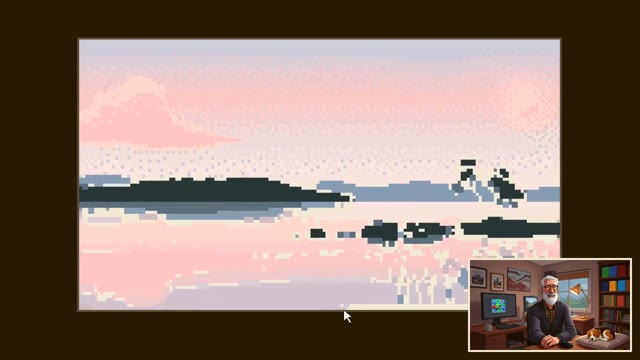
S01E01 · Five Rocks and One Wrong Side
Glen paints a lake at dawn on a 160 by 90 canvas with a sixteen-colour palette (four families of four): a sky dithered from deep blue through rose with a happy nine-pixel cloud, a far ridge of pines suggested with three greens, a soft hill anti-aliased by hand, and still water with a few ripples. After the break he adds five rocks on the near shore (big, small, big, small, middling; an odd number looks natural). He a…
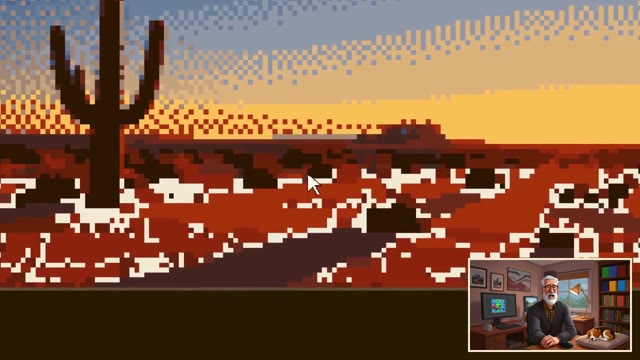
S01E02 · The Desert Mesa and the Staircase in the Sky
Glen paints a desert mesa at sunset on the usual 160 by 90, sixteen-colour canvas: a sky dithered from violet through rose and orange to pale yellow, far rust and terracotta mesas, a middle mesa anti-aliased by hand with the sun on the right, then three foreground rocks, a twelve-pixel saguaro, scrub, stones, rim light and long plum shadows. Because he rushed the sky with equal-width checkerboard bands, it came out b…
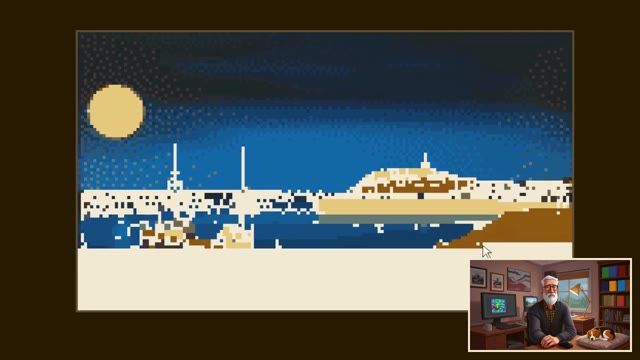
S01E03 · The Harbour at Night and the Sixteen That Were Seventeen
Glen paints a harbour at night on the usual 160 by 90, sixteen-colour canvas (four families of four): a navy-to-slate dithered sky, a cream moon on the left, Gerald the star paying a visit, a far plum-black headland with a lone amber-lit lighthouse, a stone harbour wall, and three moored boats (rowing boat, cabin fishing boat, masted dinghy). While mixing a warmer brown for the hulls, the program quietly added a seve…
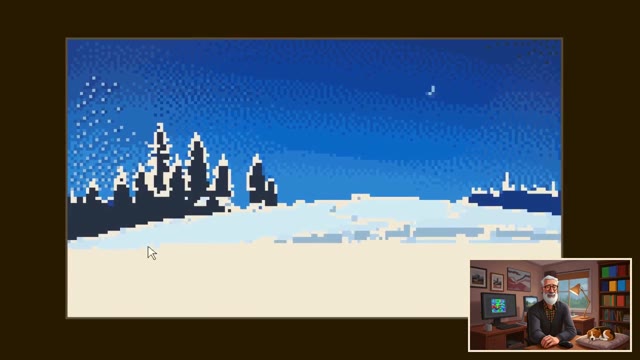
S01E04 · The Pine Ridge in Snow and the Five Identical Trees
Glen paints a pine ridge in snow at blue dusk on the usual 160 by 90, sixteen-colour canvas, counting the palette strip aloud at the start (four dusk blues, four snow greys and cream with no pure white, four pine greens, four cabin colours including one ember), so nothing sneaks in. The sky is a graded dither with a fourteen-pixel streak of cloud, the far ridge is three dull greens with a hand anti-aliased hill line,…
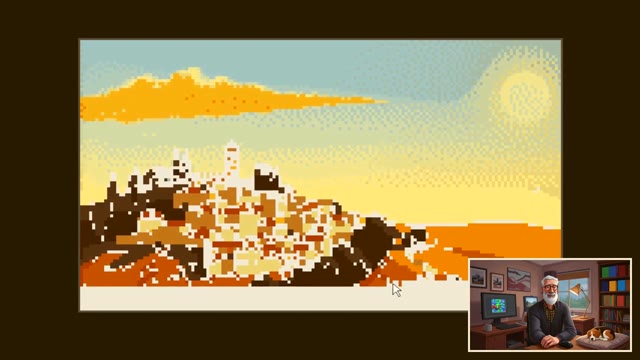
S01E05 · The Village on the Hill and the Shelf of Houses
Glen paints a hill village in golden afternoon light on the usual 160 by 90, sixteen-colour canvas (counted aloud, four families of four, each accent colour assigned a single job: ember gold for lit windows, rust red for the tower banner, shadow plum for long shadows, dusk grey-blue for the bell slats). He dithers a gold-to-blue sky with a thirteen-pixel loaf-shaped cloud and a pale sage far ridge, then builds six cr…
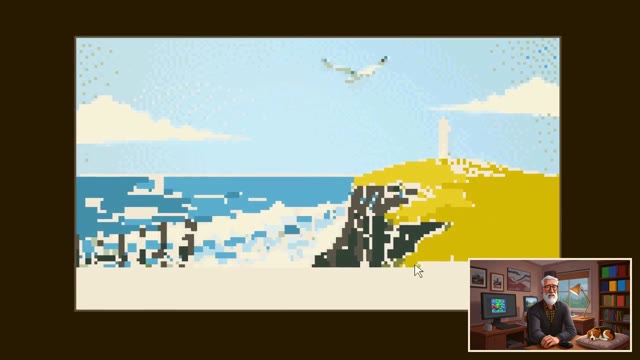
S01E06 · The Sea Cliff and the Gull the Size of a House
Glen paints a grassy sea cliff on a bright windy morning on the usual 160 by 90, sixteen-colour canvas (four sea blues, four sky blues with cream, four cliff colours, four single-job accents: rust red for the lighthouse band and a walker's coat, amber for the lamp, shadow plum for shadows, gull grey for wing tips). He dithers the sky in graded steps with a wind-streaked cloud and a nine-pixel cloud, paints a pale fea…
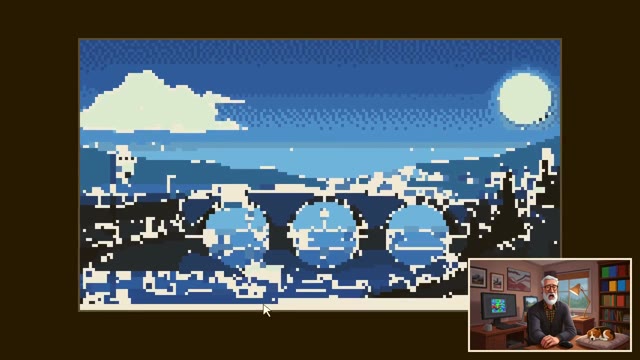
S01E07 · The Lantern Festival and the Reflection That Wouldn't Match
Glen paints a lantern festival on a river at dusk on the usual 160 by 90, sixteen-colour canvas (counted aloud, four families of four, each accent given one job: gold for flames, rose for the low sky, rust for lantern cords, plum for shadows). The big lantern on a post at the left end of a three-arched stone bridge is the light source, so the light comes from the left; every other lantern is just a candle. He dithers…
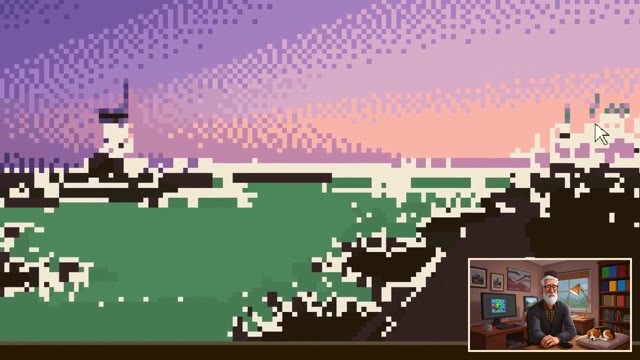
S01E08 · The Marsh at Twilight and the Horizon That Wasn't Straight
Glen paints a marsh at twilight on a 160 by 90, sixteen-colour canvas, counting the palette aloud and giving each accent one job: pale red for the last sunset band, cool grey for the windmill, dark grey for the track, and darkest indigo for deep shadows. He builds the sky with graded dithers, then draws a far horizon that is perfectly straight but appears to sag because dark pixels near the middle carry visual weight…
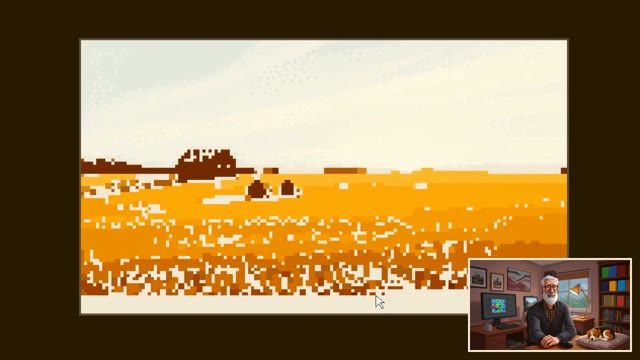
S01E09 · The Wheat Field at Noon and the Fifteen-Colour Sky
Glen painted an autumn wheat field at noon with a red barn, two haystacks, a fence, and a distant treeline. At the start, he discovered that two of his sixteen palette colours—the 'bright cream' from the white family and the 'cream' from the structure family—were visually identical, reducing his effective palette to fifteen distinct colours. He chose to proceed, treating the two creams as a single colour shared acros…
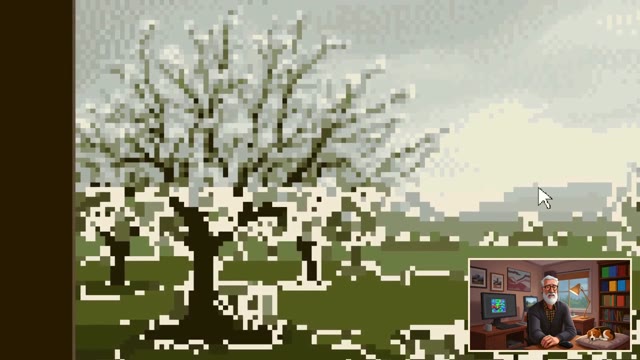
S01E10 · The Apple Orchard and the Rain That Couldn't Be Seen
Glen painted a rainy spring evening in an apple orchard on his 160x90, sixteen-colour canvas. He attempted to depict the rain by drawing faint diagonal lines across the sky and middle ground, but they disappeared into the muted grey and olive tones, making the scene still feel dry. Over the break, he changed his approach: instead of drawing the falling rain, he painted its effects on the world. He darkened the grass …
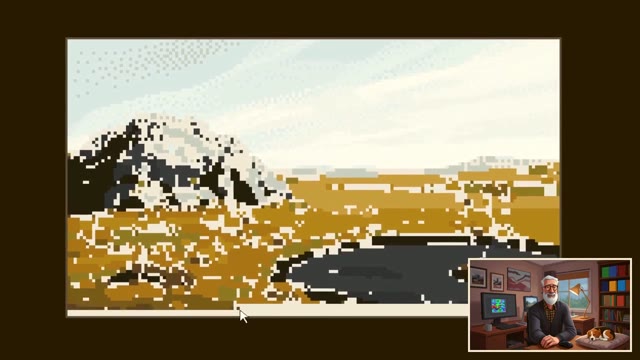
S01E11 · The Highland Moor and the Two Shadow Greys
Glen painted a highland moor in high summer at mid-morning, featuring a granite outcrop, a black peat pool, a lone hawthorn, and a distant ridge. The core lesson of the episode was palette organization: he began with a palette card where two distinct greys were both named 'shadow grey' and other colours had vague, comparative names. Throughout the painting, he diagnosed and cured this 'identity crisis' by giving each…
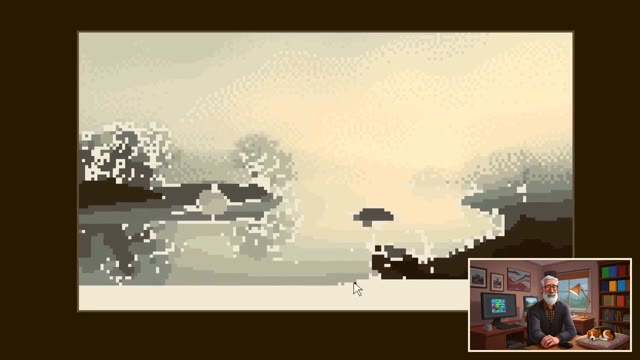
S01E12 · The Foggy River Valley and the Window That Took the Eye
Glen painted a foggy river valley at dawn on his 160x90 canvas, using a sixteen-colour palette of soft golds, greys, and peaches. The scene featured a low stone bridge, a line of bare trees, a small island, and a waiting rowboat. During the painting, a small rectangle of deep rose, intended as a warm dawn reflection on the distant water, became too prominent—a 'loud quiet' that hijacked the viewer's focus. Glen diagn…
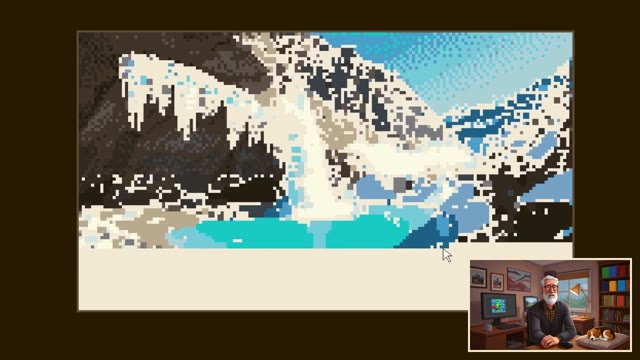
S01E13 · The Frozen Waterfall and the Ice That Wasn't There
Glen painted a frozen waterfall in a steep-sided canyon at midday on his 160x90 canvas using a sixteen-colour palette that notably lacked a dedicated 'ice' colour. The central challenge was to depict clear ice—a transparent solid—without the appropriate swatch. His initial attempt, painting the waterfall as a solid white shape over the dark cliff, failed to convey transparency and looked like a flat sheet. He correct…
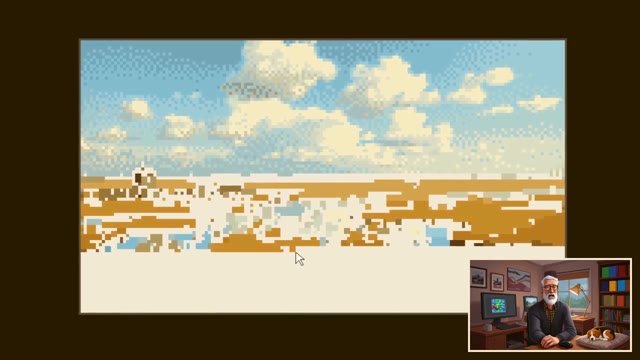
S01E14 · The Salt Marsh Low Tide
Glen painted a wide salt marsh at low tide under a hazy late summer sky, using a sixteen-colour palette that included a single, powerful saturated blue. He challenged himself to build the scene using only nine specific landscape elements (cloud, desert, boulder, rock, field, grass, pond, reflection, tower), interpreting them creatively—like turning a 'boulder' into a grassy hummock. His mistake came when he used the …
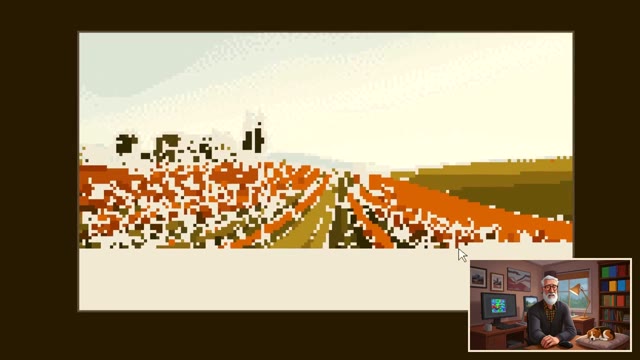
S01E15 · The Vineyard at First Light and the Hill That Would Not Recede
Glen painted a terraced vineyard at dawn on his 160x90 canvas using a sixteen-colour palette where each colour was given a specific, descriptive job. The central problem was a low, mist-shrouded hill on the horizon that refused to recede into the distance; its values were too dark and saturated, making it visually compete with the middle-ground vineyard rows. Glen diagnosed this as a failure of aerial perspective. In…